A Universe without Market Makers

I think it is worthy to note that a bunch of people go out of their way to save on the 0,1% fee on the FX. So every fee on CX trading will deincentivise trading there even though it would be more psychological than monitarily. The flipping of wares is also adding a fair bit of (needed) trade volume.

And “value of the ask order” and “similar fees to storage in warehouse” doesn’t match. Minerals and ores usually have a value of a few dozen per ton while in software for example it can be millions per ton.
If it would be everytime you place a ask it would deincentivise trading as every trade would cut a piece out of your margin which incentivises vertical integration (as little trading as possible). And if it would be time based it would be the “hot potato” game lowstrife mentioned: everyone wants to sell fast and little stock is available on the market which reduces stability.

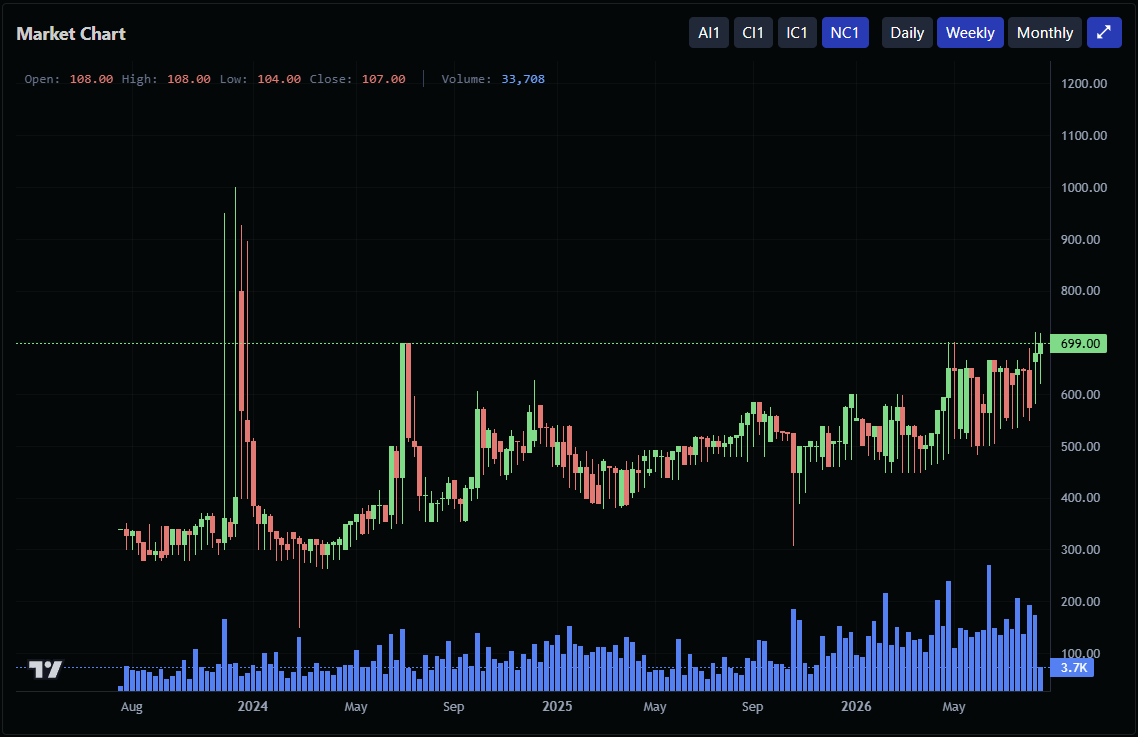
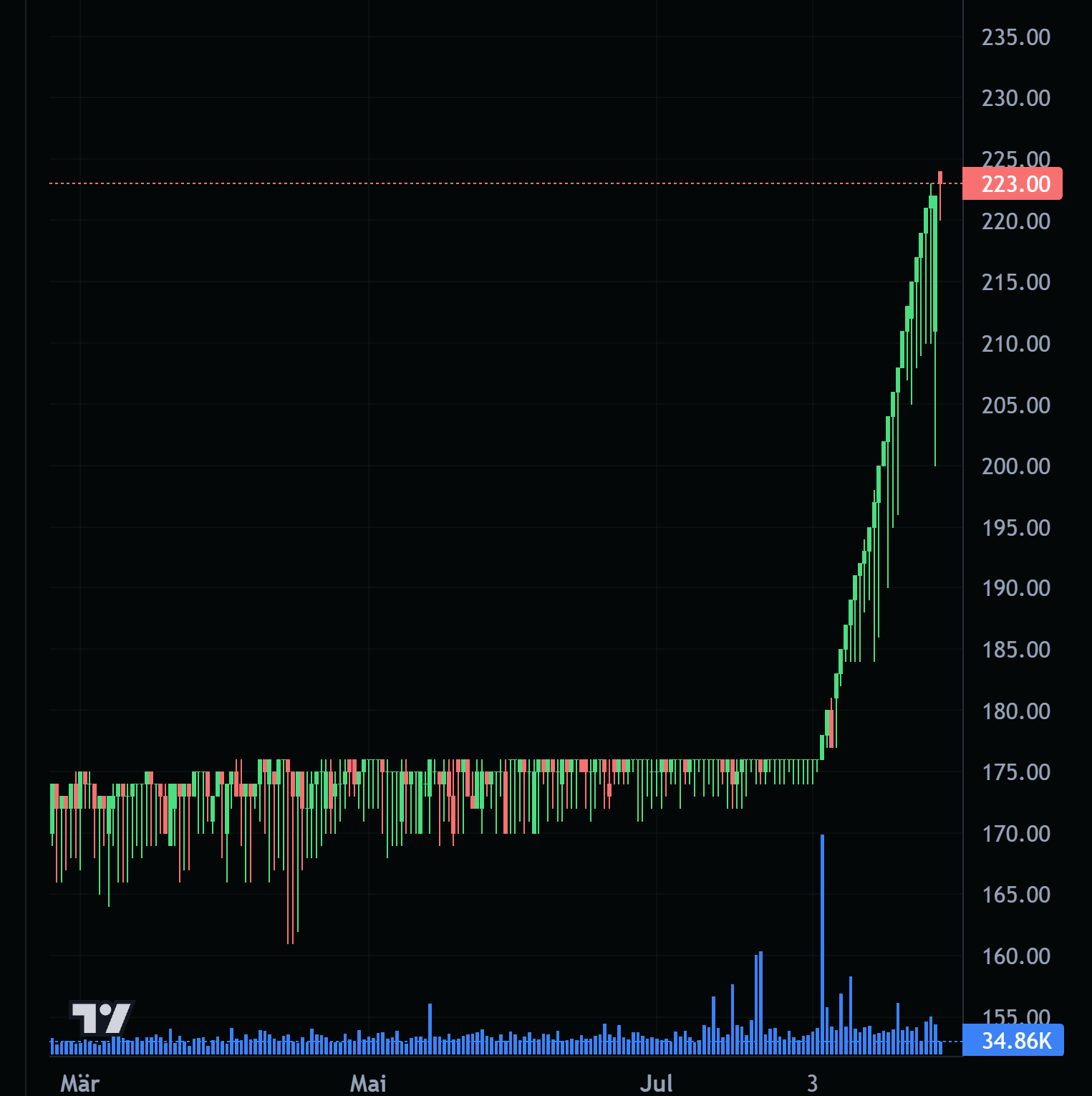
Let’s see where things go now that DW/RAT are 10% more expensive (with adaptive MM) and how the other base materials react.

As a %basis, storing Ores and such (notwithstanding the variable cost of more WAR units), due to their high volume/weight requirements equates to about a 0.5% cost.

LST for example, you can store 180 / WAR, costing 100 NCC/wk. Selling at 160 currently, makes it equivalent fee of 0.34%/wk to store on the WAR vs free on the CX.

Therefore, the high-value, high-density, product should have a similar cost-to-market, is my point. Not on a per-week basis, but a per-order basis

1 Like

Do you view providing liquidity to the markets as a bad thing? Sure, it provides competition against people who are placing orders, both bids and ask. But it provides better marginal prices for those who take liquidity.

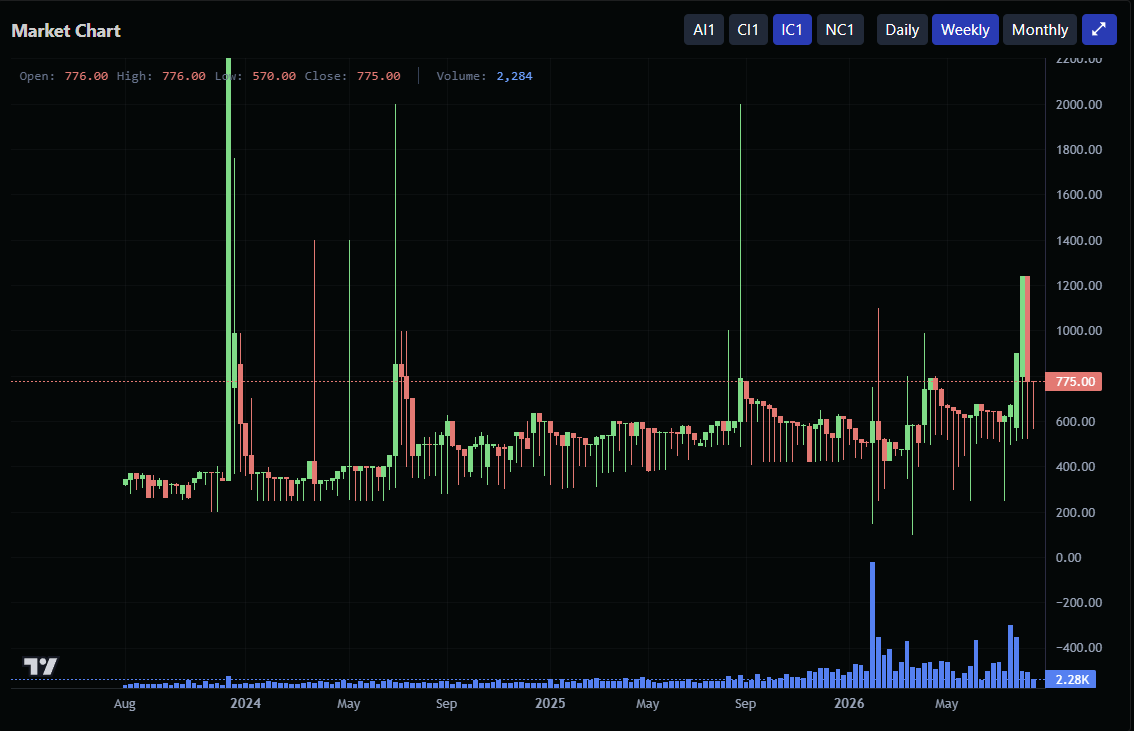
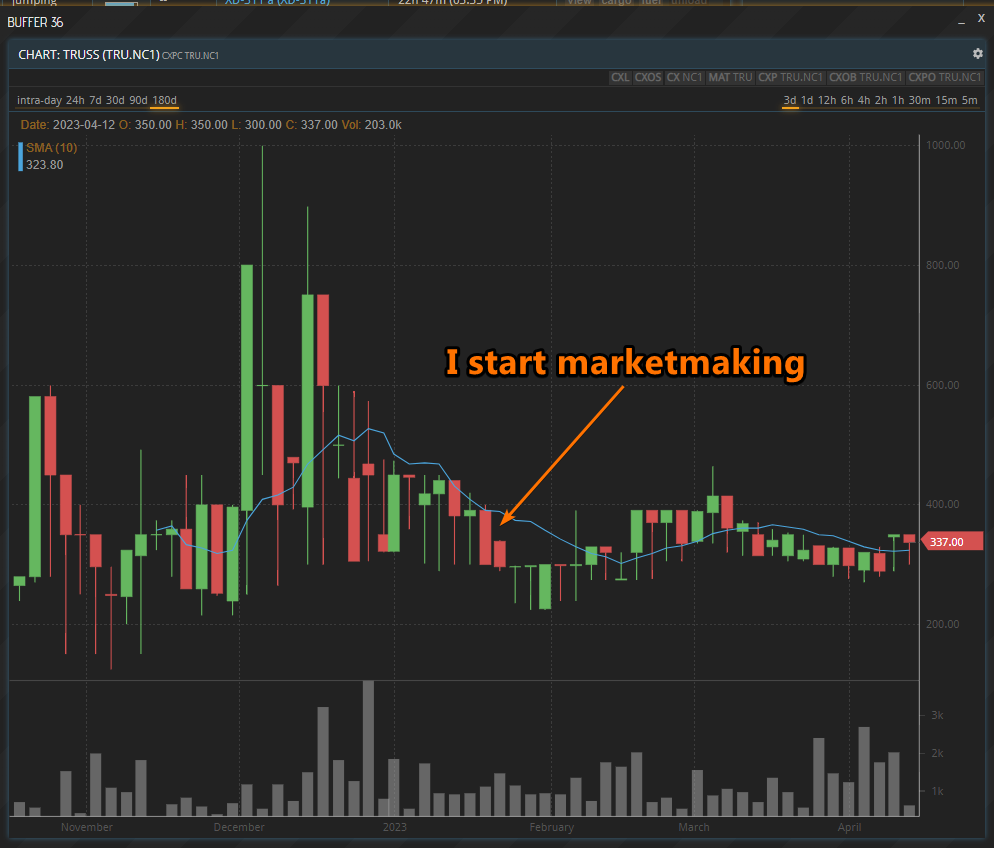
Being able to more reliability execute orders, avoiding shortages, is the primary action I try to take with most of my liquidity providing activities. I’ve been pretty successful at being able to eliminate the “well there are no more TRU at any price I guess I’m fucked” situations for the markets that I quote. Comparing the price charts between CX’s for the same item shows this quite starkly

This was an example from years ago when I first started doing this.

Is it profitable for me? Of course. But I hope it also provides a more pleasant trading experience for anyone trading in moria or antares, knowing that any given market will have a reliable person to buy or sell from at any time.

Someone needs to post the first order. And I think penalizing something which MUST happen is a bad gameplay mechanic.

Especially if you only penalize sellers, and not buyers. I would rather have flat trading fees (like we see in the FX market) if you want to start charging fees for player trade. But, again, SKLS raises a fair point that people will see that as an unusually outsized cost for their operations and it will have an outsized impact on player trade. Which IMO is a core gameplay mechanic. So while there is a world in which transaction fees can be implemented, we have to be very careful.

1 Like

Exactly my point, the system for charging storage fees already exists, so flat trading fees is the logical parallel?

Especially if you only penalize sellers, and not buyers

The point here, is that buyers should be able to adapt and change their ‘Demand’ regardless of Supply, and the Sellers, already have their margin, and profit baked in (absent inflation) - the goods already exist.

You could do half the desired penalty on both sides of the market, but that would bring in ‘double taxation’ concerns.

A Bid, is a hypothetical, an Ask is already realised.

However, the price adjustment for basic materials will also have long-term effects, particularly regarding the two points you’ve already mentioned.

a) Everyone is affected—every production process requires RAT/DW, including the production of RAT/DW itself.
b) As players, we don’t know how often RAT/DW is purchased by the system via the market mechanism versus how much is actually sold by players.
c) Players with many bases might be able to absorb the 20% cost increase for longer, given their high levels of self-production or stockpiled reserves.
d) For players just starting out, I’m not sure if it’s even worth producing RAT/DW; it might make more sense to focus on mission contacts and simply accept the prices.

Let’s see how things play out…

Are we seeing a bottom forming, or is RAT heading to 300? Everything still okay on your end?

beatings will continue until food industries are developed.

Cost+ price should be 180 or so, but as long as people aren’t expanding RAT production, hyper inflation will continue. 10d ROI atm, among the best base plans available

1 Like

Let’s see how the player count on Hortus - Promitor (VH-331a) develops ^^

It is just the markets reacting to hundreds of bases for basic materials missing. BSE will be way worse as it was waaaaay below value so basically nobody produced it.

2 Likes

We will know when the economic report drops in a few days. Will be the most important economic report the game has ever had.

Will give enormous insight to see if production has been adjusted to fill the gap, or not. If there has not been any meaningful adjustment to production yet for BSE\RAT, then yes things will continue.

Considering I haven’t seen substantial movements in carbon\iron\lst markets, I don’t think there has been substantial development.

3 Likes

I think the internal reserves are even higher there, and the materials are heavy goods; the impact on their pricing would come a bit later. LST is the foundation for many product lines.

The price increases have caused some of the ‘parked’ goods to disappear—a nice side effect. FF/SF prices would need to rise a bit more for that ‘gate thing’ to become useful.

Disclaimer: I am a retired player who quit years ago. Also the discussion kind of drifted away from the original topic which was a universe without market makers. Please forgive me if my gameplay experience is 4 years out of date.

There are many issues but the biggest two issues are as follows:

  1. Close the loop on the monetary system: New players require money from existing players. Quitting players need to have their money drained away and distributed back to everyone else.

  2. Add consumption: Production always requires consumption as a purpose. Either the developers add artificial consumers like NPCs who can spend their salary on the consumer market or the players themselves become the consumers.

There is no way around these two issues.

The first one is actually not that big of a deal, there are so many ways to fix it that the devs can do whatever, but my favorite was this one: You charge a liquidity fee on both positive and negative balances to the issuing institution (government or bank). Whenever new money is created, you write down the creditor and debtor and create both the positive and negative balance. Eventually the positive balance disappears and this also gets rid of the negative balance. When a player quits the payments are routed to pay off the negative balances (which no longer grow) first. Might be difficult to implement though so I would leave this up to the devs what their favorite is. Basically this is a modified Bancor style arrangement.

The second one is probably impossible to do for the devs because building a realistic consumer simulation takes a lot of time and economic expertise, is easy to get wrong and has the risk of the simulation not being fun to play against. Like my idea would be to build a Fisher market on every planet for the consumer side and this opens a can of worms because you dont want to have the NPCs be able to save money and you also need a labor market to start paying the NPCs. The labor market is kinda hard-ish to balance because you basically bring in a huge amount of politics in here. If there are more workers than jobs the salary collapses or you need to invent unemployment benefits (who is gonna pay that). If there are not enough workers I think its fine though because they will just spend the exploding salary back into the economy although its possible there could be a salary price spiral.

Also even the basics themselves are kind of crazy. The Fisher market is tough because it opens a big question. Basically you give each worker a salary based on the labor market (ignore it for now). The players put their consumer goods on the markets like a commodity exchange. The NPCs then try to spend their full budget based on their utility curves for a given commodity, prioritizing the ones they prefer most. What if there are not enough consumer goods? The price of consumer goods goes through the roof to capture the full expenditures but this is a contradiction with player set prices! So now the NPCs have savings which we didnt want them to have. Maybe the NPCs can put up their own bids on the consumer markets.

I didn’t even talk about how the salaries would be set… Well in this case we could say that the players set their own salary bid, the NPCs then choose the highest salary first. This leads to the unemployment issue.

Now onto the least realistic option: The devs add utility to items directly. Lets be honest, youre playing the game because you want to build a business so expanding your business is the own goal in this recursive self contradiction. You guys are playing capitalism for fun while real world capitalism is wayyy less fun. Ultimately you kind of have to let go of the idea that building the business is the core reason to play the game if you want the players to be the consumers. The devs have to add things that do not have anything to do with business building whatsoever. Paraphrased you want to build a block building game where building the nicest castle or space station requires you to gather materials from the environment and the thing you build gives you street cred. Back when I played the street cred was how many bases you own but as you heard from me thats self referential or circular reasoning.

I’m sure the devs can figure out the theory and the algorithms but you have to compare the simplicity of the market makers vs whatever box of pandora you’re opening up. It a cost of development vs paying user base growth argument. They need to keep the lights on after all.

So if someone could step up and make like a simplified fan game using the same commodities but with a functioning consumer market that would be nice and maybe the devs can learn from that.

Also I’m sorry if I got something wrong. I’m not sure how much I even remember about the game but I do know that I liked it.