A Universe without Market Makers

Basically all goods with MMs were at or close to them for a long time on most CXs. The only exception woul be OVE and somewhat SF and DW

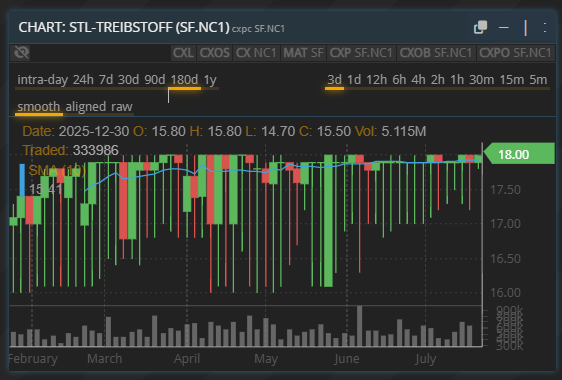
SF was is on the MM cap since half a year ago:

And bfabs were glued to it for as long as I play:

(I would like to be able to filter out spikes to get a more precise chart)

1 Like

Yep. Price cap was usually high enough, and profitable. Nowadays, one fires up exchange trading view, and price caps hurt your eyes on most goods :o)

Outside of RAT, DW, SF, FF, and the BFabs - what are the “most goods” that are hitting the “price caps” that you are experiencing?

Are you perhaps referring to the broker price band? I know there have been some problems with those in the past few months.

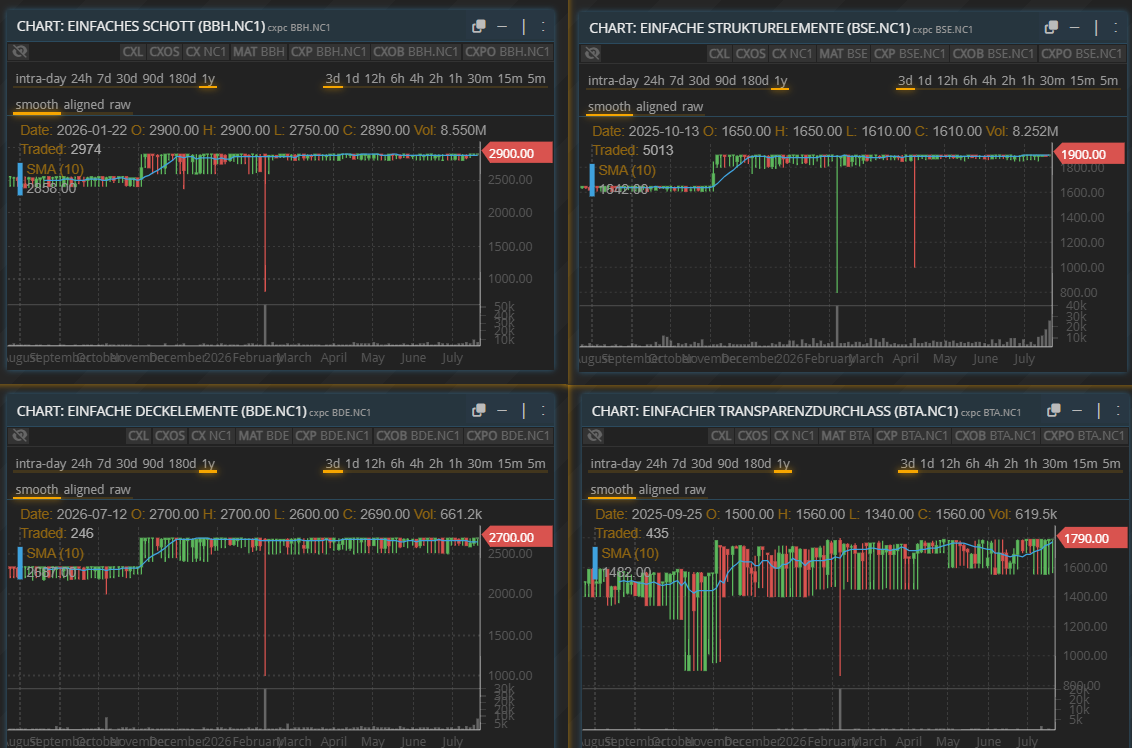
Okay, I am still baffled, the only materials with an MM that seem to affect trading are:

MCG, BBH, BDE, BSE, BTA, DW, OVE, RAT

There are a bunch of other materials with purchase only MM at absurd levels (ie RCO at 400) - but they have no impact on the market (with RCO trading around 2000). And there are some purchase only MMs that are reasonable (CBL 91k; CBM 63k; CBS 42k) but again, these provide a minimum price to sell them at - they don’t cap the maximum so it wouldn’t create the affect you are describing.

And most things don’t have MM - for example I looked at all items under Electronic Pieces and none of them have an MM.

And for fuel (SF) - the price for 2025 was generally around 15.50, and jumped up to around 17.9 (which is close to the MM - so there is a price cap) in March 2026 - so the price cap has only affected the market for the last 4 months.

Cargo cults instead!

It shouldn’t be hard to monitor supply/construction of key products such as RAT/BFab/SF etc and their availability in markets. Then instead of “random” rewards for doing the missions in the game, the rewards increasingly become weighted towards the under-produced goods which would then end up on the market if unrequired by the individual. Gives the chance for some supply-demand corrections but without the risk of a universe shortage.

One thing I think hasn’t been properly discussed here is the concept of Money Sinks vs Money Facuets

Currently, the MM Exists (somewhat) in both realms, but inflation is being driven by the Faucet being larger than the sink.

To borrow concepts from Eve Online, monetary sinks exist in many forms (by destruction in combat, trading tax as a % of volume, and developer intervention).

Currently, our sinks are very minimal - POPI, COGC, degradation and MM sells act as sinks, destroying value/currency, while faucets are much higher (Faction Contracts, MM Buys, New Player Creation; possibly also experts could be considered here).

While, in theory, MM sells neither create nor destroy value, if they are provided at below-cost then they are a net generation.

I think current developer work on fixing MM and New Player Experience should help, however inflation will still exist as long as monetary creation > monetary deletion.

Considering the current extent of inflation (and factoring in the 20x simulation speed), it should perhaps be considered whether MM alone are sufficient balancing here.

Consider
A) a CX trading fee of a low, but not insignificant amount (0.5% or lower, 1 currency unit minimum) - this would bring them to parity with LM fees
B) Contract fees, similar to above
C) Increasing the weight and/or reducing the affect of POPI possibly by reducing CM supply of needs (thus requiring more POPI investment/upkeep) - it’s noted that this is currently non-linear (as we found out by inactive accounts being culled - perhaps consider a more Logistics curve style?)
D) Increasing the speed/significance of degradation
E) as mentioned above, have faction contracts focus on below-cost materials (that do not have a MM), thus driving demand for them and bringing them to parity
A major factor not often considered is account deletion - a bunch of money gets removed when players leave.

I expect currency supply inflation to slow as lower tier goods become more valuable, meaning less of the economy will be able to support “mm faucets”. Whether this results in equilibrium I’m not sure.

However, the rest of the points are valid.

1 Like

One of the two occurances of the money supply decreasing was after a large account holding close to 2b was deleted

I note looking back that this has been previously reduced (back in 2021)

I would love to see a POPI (and gov) update. But first letting the MMs settle and updating politics to would be nice.

That holds true for the balance sheet alone — but we do not know what share of the inflation this accounts for. The problem is that this does not structurally alter the existing imbalances in the market.

A fair amount of capital has now been tied up in setting up the gates. Now it’s time to do something for planetary governance again—whether it’s quality-of-life improvements or new features.

Market Maker - One suggestion would be to reduce “market placements” (which serve solely to optimize storage space) by 1% once a week, without transferring the funds to the player. Let’s say Player X has parked 1,000,000 DW at a price of 500 ICA because they lack sufficient storage space. That amounts to 100,000 tons. A 1% weekly reduction would be 10,000 tons—meaning roughly 1.3 million ICA are removed from the system. Alternatively, the market mechanism could pass those 10,000 tons on to players with active buy orders; in that case, the resource wouldn’t be lost, and the deflationary effect would be limited to the price difference.

2 problems i see here. inflation is when the money in a system increases faster than the growth of the goods, yielding to more money per good required for trade to occur. Removing the goods will cause the inflation to occur faster, just because it is worth 500 ICA doesnt mean that takes 500 ICA out of the economy. What is needed is something that removes money without effecting goods (in MMOs this is repair cost, teleport and travel fees, crafting fees, etc)

if you are auto supplying buy orders, the drive to make higher buy orders goes away, people will just drop 0.01 buy orders and wait for their turn at getting their items.

Not sure what you want to say with that as in the bigger picture inflation is mostly the change of the money/wares ratio in a system. So if wares are moved but the total amount of wares and money doesn’t change. Except you mean it so that the station takes some wares as a fee and sells them and keeps the money. Which in return would would mke CXPC to actually understand and wouldn’t work at all with wares that have no bids or wares that are sold in single units.

What you are missing here is the delta, not the whole value.

If Item A costs X amount to produce, and the entity provides it at Y Value; then X-Y currency is created/destroyed. In the case that items are replaced with currency, then our entity needs to provide less currency than the cost of manufacture; and vice versa, if the item is created in exchange for currency, the entity needs to destroy more currency that the equivalent cost-to-produce.

What is created or destroyed is not the WHOLE value of the item, merely the difference between it’s ‘real’ value and ‘market’ (in this case, arbitrary) value.

yes - that’s how it is in the real world or not^^

However, we are dealing with a game mechanic here that has other consequences—such as the fact that goods don’t require storage space when they are sitting in the auction house at exorbitant prices. These goods aren’t actually “on the market”; effectively, they have simply been offloaded elsewhere to avoid storage fees. Consequently, removing these goods has no impact on inflation—only on the players who use this feature. Players are then faced with a choice: simply lose the goods, pay the storage fees, or sell the goods at lower prices.