Release date
The Orchestration release will be released on TBA
General Notes
If your APEX console is stuck in a loading state after the update, please make sure to refresh it once after the update to ensure you got the latest version.
Shipping Routes
Ships can now fly routes on their own. A route is a list of waypoints, and every waypoint has a list of steps the ship carries out on arrival: refuel its STL or FTL tank, load or unload a material, pick up or drop off shipments, or wait for a set amount of time. Once a ship is assigned to a route, it plans each leg, flies to the next waypoint and works through the steps by itself. If a step can’t be carried out yet, for example because the fuel it should take isn’t in storage, the ship waits at the waypoint until it can. Shipment steps only move the goods, so the pickup and delivery conditions of a contract still need to be fulfilled as usual. Routes can set to be repeating, meaning the ship will start over at the beginning of the route once it finished one loop.
While planning routes is open to anyone, assigning ships to routes is a PRO feature.
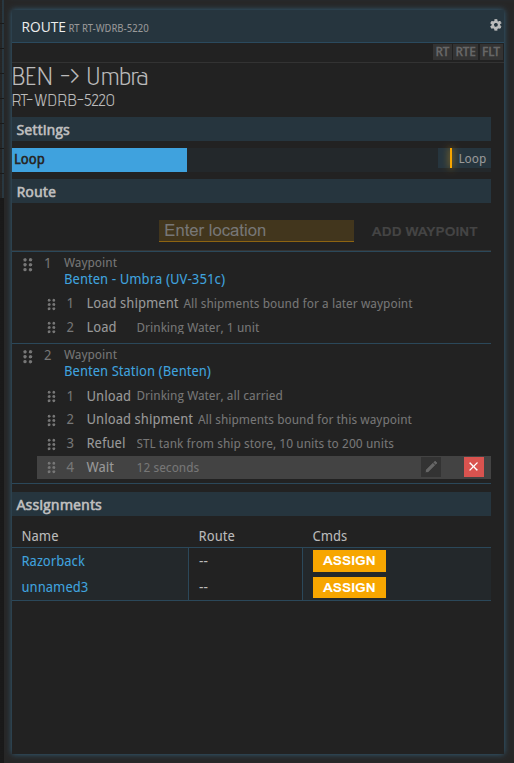
You can find more information about routes in the handbook.
News
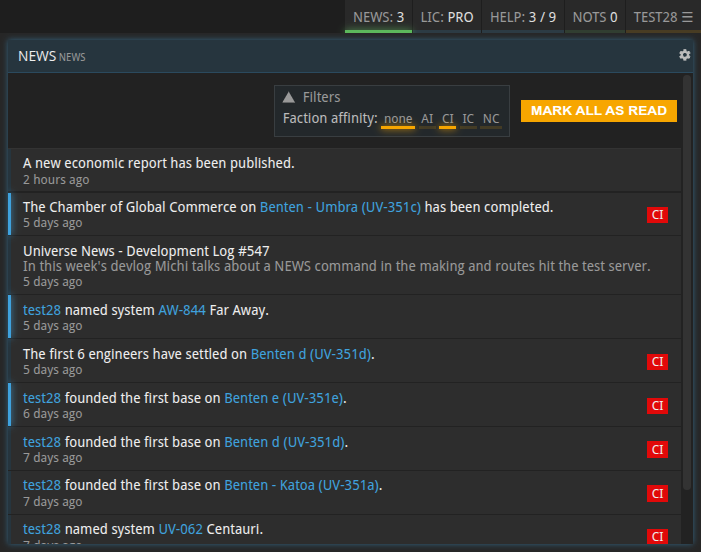
The new NEWS command keeps you up to date on what is happening across the universe. It reports when planets and systems are named, when a planet is colonized for the first time, when a planet gets engineers or scientists for the first time, when gateway links are established and when planetary projects are completed. New devlogs and the monthly economic report show up there as well. News can be filtered by faction, including news from outside faction space, and the command keeps track of what you have already read, so you can see at a glance what’s new since your last visit.
Changes
- Loan installment conditions will now use the FX rate at the time of fulfillment in order to prevent a rare issue where all subsequent loan installments will be booked with very high valuations.
- Improved the user selector: the result list will not be clipped by tile or buffer borders. An exact match will be shown first, then prefix matches, then the rest of the search results
- If a ship is being upgraded in the shipyard its status and the upgrade’s ETA are shown in
FLT - Ship names can now consist of characters from non-Latin alphabets
- Mission calculation performance in
FLThas been increased
Fixes
- A recipe’s main output is now shown in
PRODQandPRODinstead of a random byproduct. - Fixed a bug that prevented proper workforce assignments if the player had a base on the planet before
- Fixed a bug that could create a CX order that will be overfilled and thus never be removed from the orderbook
- It is possible to create blueprints where the required reactor power exceeds the produced power of the quick-charge reactor. Ships configured that way are not able to start a flight. We now prevent to save such a blueprint and show a warning.
- Fixed the last rare cases where moving the cursor from the screen selector to the actual list of screens would hide the list before reaching it.
- Fixed a bug where it was not possible to provide a service level agreement of 100% for a gateway upkeep
- Fixed a bug where a base would sometimes receive a single workforce, even if none was requested