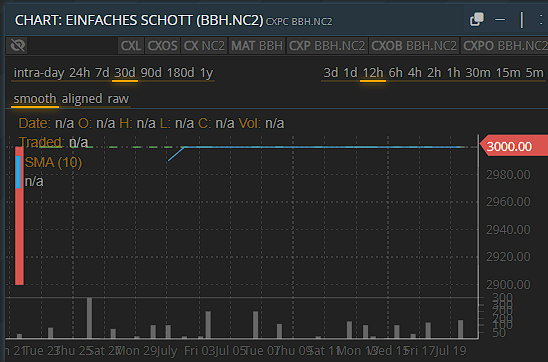
In this week’s devlog Michi talks about implementation details of the dynamic market makers.
You can find the full issue of the development log here.
In this week’s devlog Michi talks about implementation details of the dynamic market makers.
You can find the full issue of the development log here.
Very cool idea and will make for a more dynamic economy.
Is the intent to apply it every mm or would it be only on the closed bracket MM?
To echo Shrewd’s question, I’d also love to know if open bracket MMs will be the target of some dynamic price calculation eventually as well, or if only closed bracket MMs will be addressed?
Furthermore, if any further changes are being considered regarding the MM system, what factors would play a role in MM price setting? Player count, total money supply, currency generation as a proportion of total currency already in circulation?
Overall though even with just what has been proposed, I think the change is great. It will open up significant opportunities for newer players given the current state of the economy.
Agree with the scope of how the system would be implemented. 2% change per week is sufficient.
What spread are you targeting between the two orders? Typical spreads we seen between bid\ask on most liquid markets in the game are somewhere around 5%, rising to 10% to reach any sort of large liquidity. Some markets trade wider, especially if there is a shortage, reaching 20 or 30%.
I would suggest the bracketed mm orders sit at a 100% spread:
Bid at $20
Ask at $40
Target average at $30 (aka “mid”)
If the average price sits below the midpoint of the upper and lower brackets, how will you adjust the brackets? Will you lower the upper bracket, or lower the lower bracket? Both would have the effect of bringing the midpoint closer to the 10-day average price.
Since the open bracket MMs serve two different roles, we cannot blindly apply the same system. We’ll start with the closed bracket MMs and get some feedback first before continuing.
We haven’t planned on any other factors than the price data for now. But we might also adjust the starting capital and faction contract rewards based on inflation data.
For now we are taking the existing bracket as baseline for the inflation factor that modifies these brackets. Do you suggest to change these?
We always change both by multiplying an inflation factor. DW example: current bracket is 121 / 19. Average price sits at 80% of that interval at roughly 100, that is ~30 off the center. The bracket will be adjusted by 1.1%. This then results in a new bracket of 122.42 / 19.21.
it seems like the proposal is a 2% change per day, not per week
Oh my bad. 2% per day, based on a 10 day moving average. I think that might be a LITTLE fast, especially at first. Perhaps 1% per day for the first 60 days, then we can move to 2% per day.
Well, the issue is the brackets are inconsistent in their percentage distance from each other.
SF - 18/6 = 200%
FF - 24/9 = 166%
DW - 121/19 = 536%
etc, etc
Perhaps 100% is too conservative, maybe 200% is the right answer, but I’d suggest making it a consistent spread between all the brackets that the dynamic mm’s will operate at.
I would suggest fixing these disparities by adjusting the bid price of the mm’s up to the target spread %.
Be mindful about applying the correct adjustment factor when trying to maintain consistent spreads.
121/19 = 536.842%
122.42/19.21 = 537.2722%
If we were trying to maintain the same 536.842%, then I would expect the following from a 1.1% move:
122.21/19.19 = 536.842%
Just a small reminder that with the bfab and other MMs moved there will be a big money sink gone so the amount of generated money will have to be cut down too to avoid inflation, and without a alternate recipe bfabs (mostly BBH and BSE) will jump up roughly 50%, not including market fluctuations, inflation and the huge gap in production capacity as there just aren’t many PP1 around. (so the price for bases could double soon).
So there should be a “advanced universe” alternative recipe for bfabs (or at least BBH and BSE) with a higher throughput and lower COGM. This could for example include advanced alloys to increase demand for thise more advanced materials and pops. A nice side effect would be that it reduces logistics for the starting profession with by far the highest logistical burden besides pure FE SME (which aren’t that much of a problem with a vertical early universe), and that it would give PP1 their role back as “the” bfab plant.
(that got longer than I wanted it to be)
Assuming I’ve understand the model correctly, here’s what some of the adjusted MM prices might look like, based on current ratios and averages
┌─────────┬────────┬─────────┬────────────┬───────────┬─────────┬─────────┐
│ Ticker  │ Cur.   │ Cur.    │ Cur. Price │ Ratio H:L │ New Low │ New High│
│         │ Low MM │ High MM │ Avg.       │           │ MM      │ MM      │
├─────────┼────────┼─────────┼────────────┼───────────┼─────────┼─────────┤
│ RAT.CI1 │ 32     │ 176     │ 176        │ 5.5       │ 54      │ 298     │
│ DW.CI1  │ 19     │ 121     │ 121        │ 6.4       │ 33      │ 209     │
│ OVE.CI1 │ 40     │ 153     │ 149        │ 3.8       │ 62      │ 236     │
│ BSE.CI1 │ 425    │ 1900    │ 1868       │ 4.5       │ 683     │ 3053    │
│ BDE.CI1 │ 850    │ 2700    │ 2699       │ 3.2       │ 1292    │ 4106    │
│ BTA.CI1 │ 500    │ 1800    │ 1780       │ 3.6       │ 774     │ 2786    │
│ BBH.CI1 │ 750    │ 2900    │ 2890       │ 3.9       │ 1188    │ 4592    │
│ SF.CI1  │ 6      │ 18      │ 16.2       │ 3.0       │ 8.1     │ 24.3    │
│ FF.CI1  │ 9      │ 24      │ 20.2       │ 2.7       │ 11.0    │ 29.4    │
└─────────┴────────┴─────────┴────────────┴───────────┴─────────┴─────────┘
In this example, the bottom MM moves by a fraction of a credit. How will the game handle that as decimal point accuracy is explicitly not a part of the price, esp. at higher prices?
The market maker orders are rounded to three significant figures, just like any other orders. The price bands are adjusted after a change in the market maker orders as well, so that the new order is matchable.
Ooh that is nice, finally non PRO and new players can use HUB, and XIT ACT there is possible.
Thanks a lot molp
(Though there should be some kind of protection in place for new player accidentally buying on HUB instead of MOR)
To which MMs will the price bands on HUB and ARC be connected?
I guess MOR and BEN, respectively.
No, their price bands are completely independent. Price bands are defined per broker.
They updated with this maintenance