Increasing the economic incentives of specialized empire production

tl;dr in the endgame, it is very easy to vertically integrate your own supplies, “this base makes x, which goes into y, which goes into z” through a dozen steps with planned, reliable inputs. I suggest increasing production bonuses to companies that stay within their chosen “specialization” of maybe 3 industry types. This would require more trading among intermediate production chain steps as you would need to externalize more and more of your supply chain to achieve this, but in doing so, achieve more powerful bonuses.

The purpose of the change would be to create more incentives for trade among players. Creating power powerful combinations for players who collaborate through trade, while retaining the ability for vertical integration if so desired.


The problem, in my opinion, is that vertical integration is a little bit too easy for companies. You’re able to go from the base ingredients all the way to extremely advanced and expensive products completely internally. From H2O–> HCP → C → EPO → NR\RBH\RSE → ABH\ASE, following the chain all the way up through 4 different industries.

At first, you’re discouraged from doing this because mixing industries on a planet has a penalty. Not only from the COGC and expert bonuses which you would miss out on, but also from your empire bonuses. Stacking those is very powerful.

Once your company grows to a certain point, you can vertically integrate everything on its own COGC world. You lose the negative incentives against vertical integration: the COGC and the Experts. The only one which remains is the ~10% empire bonus, which is reasonably small. I suggest buffing that.


My proposal would end up changing production bonuses and efficiencies to add economic incentives to stay within a player-chosen few industries at an empire-wide scale. We don’t want it to be as restrictive as those on a planet, I wouldn’t want all of us having to chose which industry to focus all 30 of our bases on. I think a good number to target here is 3. Three industries which you get powerful bonuses for participating in, even unlocking potential bonuses which impact other aspects of gameplay other than just production speed.

  • capacity buff to your ships (and bases!) carrying metals, making metallurgy focus easier as you’ll be hauling around many many rocks
  • access to powerful specialized recipes that offer better ROI
  • improved space granted per permit
  • “Marketeer”: gain x% more currency when selling an item (you fabricated) to a market maker. Items bought from other players yield the normal amount.
  • Your workforce requires less consumables per day
  • You pay reduced taxes to planetary governments, the difference is made up via inflation
  • “Govenator”: worlds require 10% less popi upkeep and COGC on worlds you govern (governor only, does not apply to parliament, upgrades increase # of planets you can apply this on, not the strength). Enables one-time prestige construction of planetary upgrades, can create a whole resource sink chain here too.
  • Can bypass the plot limit on planets for settling new bases!

Now imagine each of these bonuses has its own upgrade chain, requiring resources into upgrading each aspect of them individually. For example, the permit area ability would only grand you +2 or +3 at first but eventually would become +50 before upgrades became exponentially difficult. And you couldn’t just magically reformat your bases to this every time you researched an upgrade, so its gain would only be realized slowly over time.


What this creates, in reality, is far more public trade among all players at the intermediate steps. Corporate and public cx players all should see increased incentives to specialize their empires, focusing more on trading with people to achieve the best bonuses.

While there are many levers to pull in the game, I think this long-term economic balancing is quite important. I’ve been thinking about these for a while but wanted to get them down in a semi-permanent location. I’d love to hear some inputs! I’m sure my exact numbers are off, there is way more work which could be done there. I tried presenting this from a 10,000 ft view of the systems at play here rather than specific variables which I trust Molp\Counterpoint can do good work on.

Thanks!
16 Likes

Thank you very much for the input! This is a topic we’ve been discussing quite a bit in the past. We actually have a concept draft in our backlog we labeled “Experts 2.0” that was meant to address this. Basically the idea is that experts would not be attached to bases, but to companies, i.e. you’d specialize more holistically and a new base wouldn’t be as much of a “restart” (where you might as well vertically integrate). On top of that though, expert bonuses would apply to a significantly higher degree for higher-tier workforces (those who actually do “expert work”), which should incentivize veteran players to “move up the tech tree” rather than stay in lower tiers forever. Company-wide experts could also make it more viable to shut down earlier bases (cause you’re not losing expert progress) and setup new, high-tier production sites instead.

3 Likes

Oh thanks for the comment! I’m glad you have at least already been thinking about this, and it sounds like we’re trying to solve the same problem. And doing the same thing, by buffing the production speed across the empire to specific things. Good stuff!

The only thing I am personally unsure of from that is applying to higher tier workforces - I’m not sure the buff to economic incentives to build the high end buildings is necessary. IMO it puts too much pressure on the bottom of the economy.

2 Likes

I also had a rework for experts in mind.

My vision was 3 level of experts:

  1. Base level experts : boost production for specific recipes
  2. Company level experts : boost production for specific buildings
  3. Corporation level experts : boost production for a specific industries

That was what I was thinking at first.

However, here’s the issue. Ideally, Prun would have the following properties:

  1. It would reward long term planning. Meaning that a player commiting to produce one thing for longer should be more productive.
  2. It should discourage self-sufficiency, encouraging trade between players
  3. Players should still have a feeling of freedom. Freedom to change their base, to do something else. If they can’t change when they want to, they’ll just quit the game.

Furthermore, we must take into account that there will be players with 30-40 bases. Currently, it’s possible to stay entirely within a faction. However, if I had to specialize in ressource extraction, I would have to operate in the 4 factions at the same time, which would be an issue by itself. This should be kept in mind, a permit rework might be necessary along side it.

I would also remind that one base perfectly feeding another is very enjoyable (FRM feeding INC, CHP feeding POL, etc), it would be a shame for players to not experience that anymore. To do large scale complex supply chain is the most regular goal I see new players coming with. It MUST stay achievable.

Quite honestly, human interaction can be tiring. To produce and sell on the market without feeling the need to interact constantly with humans to stay efficient, is something nice about prun.

All in All, I believe that the game is fine as is. Yes late game player can way too easily do vertical integration, but to do that, they needed capital, a ton of it. IMO, this is a privilege that is earned. In the ADI, I tried to convince someone that self-sufficiency is a very bad idea early on. I won’t explain the whole argument but players need cash, which only happens when selling things to the CX.

I also fear that any meaningful change would make the game far less enjoyable for many of us. PLEASE be very careful with it.

My suggestion would be the following : Try to make it harder to do vertical intergration early on, but keep the late game exactly the same.

Here’s an idea that could implement that : First, we keep experts as they currently are. Second, Players can unlock new tiers of building over time. They start by only being able to build pioneer level for 2 industries, decided by the starting profession. Then, they get exp in the industry of what they are producing, unlocking SET level buildings, then TEC (etc) over time. New industry PIO capabilities would be earned by upgrading HQ.

This way :

  1. New players are encouraged to go tall early on
  2. TEC level of vertical intergration would remain possible
  3. SCI level of vertical integration would probably be impossible in short - medium term (but possible long term), encouraging people to cooperate for said supply chains (One person being able to do SCI building in each industry, at least)

I hope I was clear and that this will help in any small way.

4 Likes

I think that is a really nuanced and well thought out post, I don’t have a single thing to comment on about it actually. I think you make a lot of really good points that are important to consider. I’ve got nothing to add, good thinking.

1 Like

I don’t have particularly strong feelings regarding this issue, though I think I tend to agree that promoting player interactions is positive. I have a personal tendency toward autarky, so I would be a bit disappointed to see that too drastically undermined though.

An anecdote from my personal experience is that, by growing larger, though I have endeavored to maintain a large degree of self-sufficiency, I have reached a point where I have had to accept procuring certain things from the market. For example, while I have dropped a couple nanoresin bases, I just buy my flux because it throws an undesirable kink in my larger-scale chemistry production chain and because it is so readily available and cheap on the open market.

I think a lot of the problem with mid-tier inputs being so scarce has to do with prestige and the maturity of the market though. Lots of people want to make ships and A-fabs. Making fasteners or microchips isn’t as sexy, and some of these either are ridiculously easy to overproduce or are so slow to make (I am looking directly at MHL) that they demand a whole base to make in any appreciable quantity, which is kind of boring.

I think I’ve made better, more coherent posts before, but this is what I have.

2 Likes

While I understand the desire to increase player interaction - or at least use of the markets - I have to say that I am probably further along the autarky spectrum and if I wasn’t able to actually build ships (from raw material to complete ships) - I would probably lose alot of interest in the game.

But I do realize that encouraging people to use the markets more is probably a net good - I am just not sure how to do that. Sometimes I feel like I am just selling my excess mid-level electronics to Lowstrife most of the time - LOL. But I am not sure how to increase the usage.

Also, thanks Filefolders for forcing me to learn a new word. LOL.

2 Likes

i’m of the opinion that the simplest way to increase specialization is to simply not tie HQ boosts to UNUSED PERMITS and instead HQ level. make it worth something.

1 Like

I think this is a bad idea because it mostly buffs old players with high HQ levels. We should try to buff new players instead. Imagine being a new player and realizing that you need a year to get that 20% production bonus that every old player already gets. The current system of unused permits already helps new players, because they start out with 1/2 bases (a 15% boost) which converges down to 10% for old players (21/22 bases is basically 1, so a 10% boost)

1 Like

it’s nice to buff new players, but that doesn’t drive specialization unless you also buff older players. the closest i get to specialization right now is aligning to cogc, and even then sometimes i don’t even do that.

As far as I’m aware, it’s never worth leaving permits unused to gain efficiency bonuses.

Bonuses are a thing that should be unlocked over time as we progress - However, I agree it’s not super clean on being implemented on an existing universe. And would be best suited for a fresh restart. But with the only other option being nerfing newer players, I don’t see many other choices to encourage specialization.

2 Likes

I second lowstrife’s point - the only reason I would have an unused permit is because I am still planning how to use it - the expense for permits at my level are too expensive not to be used. (For those who don’t know my most recent permit will cost me 55.9M in A-fabs ALONE). So “senior players using unused-HQ bonus” is not a thing. At 33 permits, if I add an “unused” permit my faction bonus goes from 4% → 4.2%, and 6% → 6.4% - which is a tiny increase.

That being said - the COGC is 25%, a full set of experts is 28.4%, and Faction is 4% for Metallurgy and 6% for construction. So you are talking about a 60%+ production bonus that doesn’t change much across profession.

I think in order to entice players to specialize you need to deal with two different issues - A) there is no benefit to specialization and B) the market is not stable for many interim products. Note that I think we need to target the larger players, because smaller players already specialize because they have a limited number of bases.

A), keep in mind that all players “local” to you have the same faction bonuses - so on a given planet EVERYONE has the same production benefit with the sole exception of a player from a different faction - but because shipping is constrained this is not that likely. So I think a production bonus linked to your HQ level - but constrained to a limited number of professions would actually encourage players to specialize as they grow. For example, assume you have a primary and a secondary profession, but HQ level 30 you probably need a 30% bonus in your primary and a 15% bonus in your secondary profession.

B) The markets are not robust enough to really allow for the security of knowing that you can buy reasonably-priced inputs/outputs. While in things like DW and RAT there is a big market, take the market for ZR - which is required for ship production. If you want to buy a ZR on the Moria exchange right now it will cost you 15,200. So say you buy 20 of them and make an LFL, the bid for an LFL is only 250,000 but the actual cost in ZR to make it is 302,000. So in order to get a supply of ZR to make profitable LFL a player needs a resource extraction base (ZIR), then a chemistry base (high-tech, you need an AML!) to turn the ZIR→ZR, then a construction base to make the LFL. Also, there are only 49xZR for sale (I use more than that every week). To encourage specialization there would need to be a much larger network of MM items available for purchase, at a price where you can process them and still make a profit - and also purchase MMs for finished materials - or at least for materials that we want to encourage people to make. The risk to my production of materials not being available (or skyrocketing in price) is why I don’t specialize. I would love to have bases scattered across the big planets making a dozen ships a week - but for many items I can’t rely on the market - carbon prices went crazy and for a while you couldn’t even get any at 1,500 each - so I went into carbon production. The way I keep the prices for my ships low is that I provide the vast majority of my inputs, so when the price of FE or LI goes crazy - it doesn’t affect my prices.

And yes, people will say that you have allied players who provide you those goods - that is fine - while it works. The reason Carbon went crazy was the largest producer of Carbon left the game - he was a corporate mate who gave me a REALLY good price on carbon. But when he left the game I was left scrambling and I had severe money problems for weeks. And that isn’t the first time a supporting player has left - which is why I am not in a corporation for now. While playing this game for years I have had many players who worked with me wander off - and each time it puts a major crimp in my operations - to the point now that profit is secondary to me - I want to be vertically integrated because it makes it easier to manage my empire. There is just too much uncertainty in the market for me to rely on it.

Anyway - there it is - my thoughts on encouraging empire specialization, and what it would require for me to actually consider specializing.

1 Like

I think a potential solution would be to link faction bonus directly to HQ level, such that each new level provides another percent, say, of bonus. I’d also like to see players get the ability to decide what to put their bonus towards. ie right now IC gets 6% Agri, 4% FP. However, there’s quite a few carbon farmers as well who I’m sure would appreciate switching that FP to RE. My proposal would be to let each faction have 2-4 categories that players can assign “efficiency points” to. Each point represents a 1% bonus to the respective industry. You’d start with 10 points, automatically assigned based on your profession, and would gain 1 point every HQ.

Here is a choice that encourages specialization without punishing new players: Each company gets to select empire-wide bonuses to some industries, which can stack. So a player doing only construction is more efficient than a player doing everything.

Don’t improve these boosts with HQ levels. That way, a brand new player gets the entire boost for their whole base right away (it buffs new players) and it still encourages old players to specialize. If you make these buffs scale with HQ levels, it makes it harder for new players to compete, which is why I am against it. The #1 struggle of this game is the new player experience.

To have any impact, the buff would have to be pretty strong, at least as strong as CogC or experts are. The current faction bonuses at around 10% are not convincing many players to specialize in just one industry after all, so 10% is not enough.

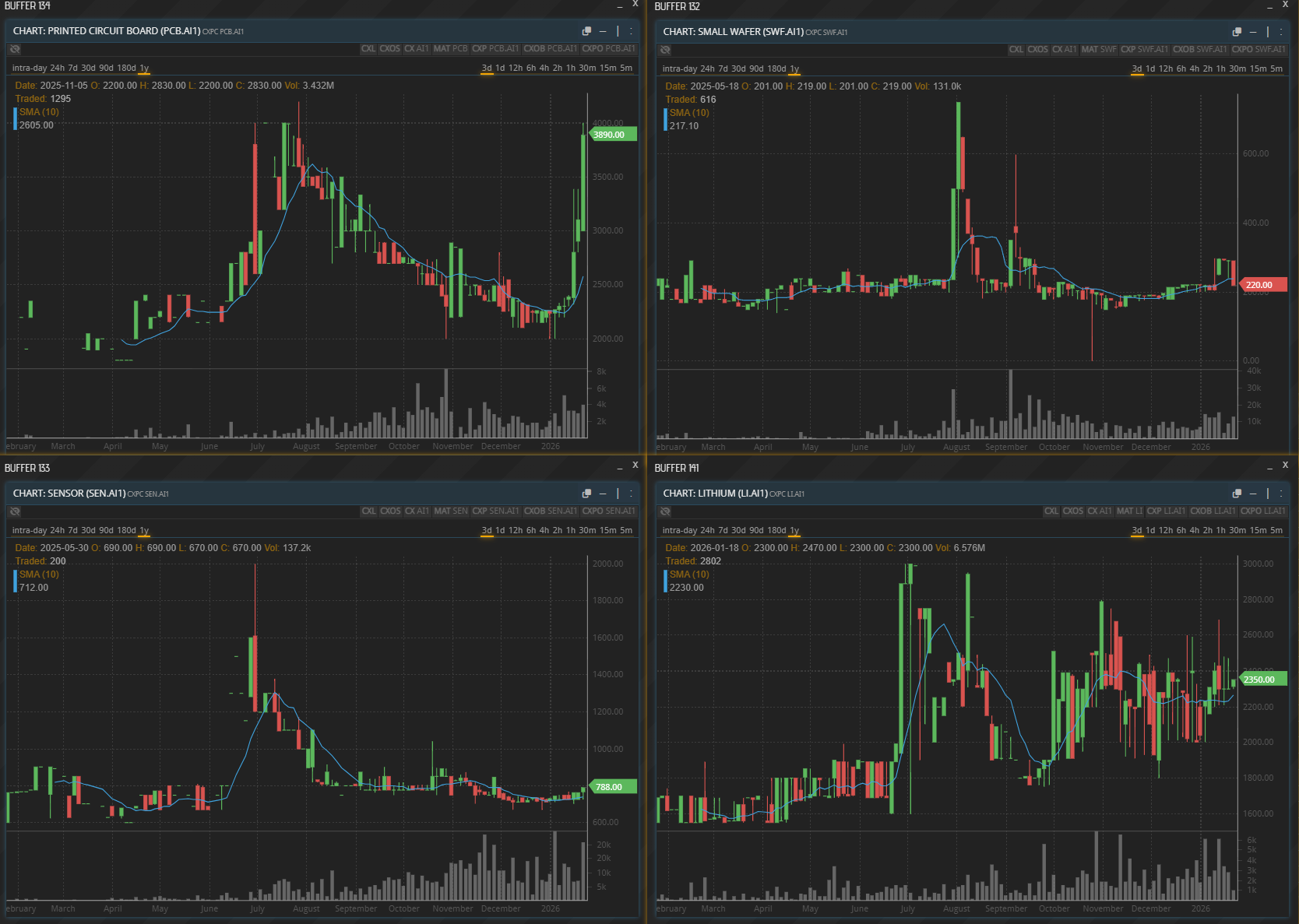
The markets are not robust, because nobody specializes. If specialization were encouraged, and we saw more incentives to buy\sell those intermediate products, you’d see a flourishing of trade. Look at what happened to trade volumes for the new electronics supplychain intermediaries after the mm changes. I would expect the same to happen.

2 Likes

I assume you meant to say “The markets are not robust, because NOBODY specializes”?

But yeah, those charts I think strongly support the idea that if we deploy a bunch more MMs to encourage specialization we might be able to remove them (or scale them back) once more people specialized.

1 Like

I have very little to add, beyond saying that I think it would be really nice if this late-game specialisation mechanic was tied to Corporations. This way it would be something that requires heavy investment from established played, but still allows newer players to voluntarily opt into (by joining a corp / being allocated a corp modification). If we’re worried about new players specialising too soon, then there’s a simple solution: Lock taking advantage of these specialisations behind the Apex Representation Centre! Have the bonuses start at lvl 5 or 10 (whatever is seen as a reasonable investment for a player at a specific point in the game) and slowly increase in breadth as the player gains more ARC levels (pending proper balancing so that it doesn’t just give established players an unfair advantage). This would also provide a direct currency sink.

2 Likes

Specialization is more work, so new players naturally avoid it.
You see a lot of early players do a lot of vertical integration at a single base despite missing out on COGC.
I don’t think new players really need to be locked out of specialization. If they want to start doing it early its not a huge issue.

Resource Extraction Collector (COL), Extractor (EXT), Rig (RIG), Incinerator (INC)
Manufacturing Basic Materials Plant (BMP), Textile Manufacturing (CLF), 3D Printer (PPF), Weaving Plant (WPL), Medium Component Assembly (MCA), Small Components Assembly (SCA), Spacecraft Prefab Plant (SPP), Appliances Factory (APF), Advanced Appliances Factory (AAF), Spacecraft Propulsion Factory (SPF)
Agriculture Farmstead (FRM), Hydroponics Farm (HYF), Orchard (ORC)
Food Industries Food Processor (FP), Fermenter (FER), In-Vitro Plant (IVP)
Construction Prefab Plant MK1 (PP1), Welding Plant (WEL), Prefab Plant MK2 (PP2), Unit Prefab Plant (UPF), Prefab Plant MK3 (PP3), Prefab Plant MK4 (PP4)
Metallurgy Smelter (SME), Metalist Studio (FS), Glass Furnace (GF), Hull Welding Plant (HWP), Ship Kit Factory (SKF), High-Power Blast Furnace (ASM)
Chemistry Chemical Plant (CHP), Polymer Plant (POL), Laboratory (LAB), Pharma Factory (PHF), Technetium Processing (TNP), Advanced Material Lab (AML), Einsteinium Enrichment (EEP)
Fuel Refining Refinery (REF)
Electronics Electronic Device Manufactory (EDM), Cleanroom (CLR), Energy Component Assembly (ECA), Electronics Plant (ELP), Software Development (SD), Drone Shop (DRS), Software Labs (SL)

If player specialization follows the path of experts Fuel Refiners are gonna have a rough time.
I know some have suggested putting them in chem, but an interesting alternative might be putting fuel refining as resource extraction.
This helps em get a lot more planets, and naturally synergizes with what sort of places fuel refiners have to be placed.

I think some more, overlapping categories could be interesting for whatever the systems ends up being.
Like
Plastics: POL, PPF
Textiles: CLF, WPL
Software: SE SL SD
Assembly: ECA SCA MCA
That could either be picked instead of or on top of a Expertise.
Having only 9 options could get a bit bland.

2 Likes

Fuel Refining is just in a bad state overall in the game. It should not be a starter profession and it should not have its own CogC. I hope they fix it eventually.

1 Like