I have hesitated to post this for a while, but I have been convinced to do so by ongoing rumblings of Bfabs and Market Makers yet again. I have reproduced the draft here in it’s entirety to assist with the discussion, with some changes.
It was back in 11/5/2025 when the Market Makers for Basic Prefabs (BBH/BSE/BDE/BTA), Rations (RAT) and Drinking Water (DW) were adjusted, but in the intervening time it feels as if the expected outcome of an active Bfab market is no closer to being realized while both RAT and DW markets are thriving. So it seems like Bfabs got a price hike and not much else – which makes me want to revisit the topic and see what, if anything, went wrong. Join me on this retrospective and let’s take a look under the hood.
Bfabs, as a quick refresher, are a long-running “issue” in PrUn. Everyone needs them, but not many people make them – leaving the market almost entirely to the Market Maker (the infinite system player). This does not appear to be an outcome that many players accept and possible solutions continue to be proposed - so why are Bfabs continuing to be such a thorn even with the slight price hike?
Before we begin, let’s set the ground stage a bit – fixing Bfabs will result in inflation as this is quite possibly the largest credit sink in the game. Removing the sink by having the credits be captured by players instead will have effects I cannot predict. If the developers designed Bfabs as a market sink to have additional control over currency volume, then it makes sense to have the universe “grow out” of producing Bfabs - and are thus working by design.
I want to approach a Bfab rework from the view of three relatively measurable objectives, so that comparing the impact of potential fixes have benchmarks:
- Bfabs should be cheap enough for new players to purchase.
- Bfabs should be available enough to supply the market against all but the worst economic pressure.
- Bfabs should be profitable enough for people to make them.
The first objective is determined by new players, as they require Bfabs to grow and develop in the game. Higher prices makes a slower game a lot slower unless offset in other ways (such as reducing Bfab requirements for buildings). The second objective is that Bfabs are used heavily in game for many actions so running out of stock is undesirable as the market reverts back to the Market Maker. The third objective is to ensure that players have a reason to make Bfabs, or potential production is lost to more attractive alternatives.
For the purposes of this analysis, all numbers will be pulled from PRUN Planner unless otherwise noted to keep data commonality. If numbers are wrong, at least they will be wrong consistently.
At this point, let’s make a chart to see what the various returns are for Bfabs, RAT, and DW (as of PRUNPlanner Recipe ROI 1/2/2026):
| Item | ANT (ANT1_BUY/SELL) | HRT (IC1_BUY/SELL) | BEN (CI_BUY/SELL) | MOR (NC_BUY/SELL) |
|---|---|---|---|---|
| BBH | 41.92d / 26d | 14.28 / 24.85 | 27.07 / 186.13 | 21.88 / 44.98 |
| BDE | 14.95d / -84.32d | 19.52 / 135.93 | 13.35 / 46.23 | 13.39 / 27.55 |
| BSE | 46.82d / 37.65d | 21.23 / 42.98 | 22.24 / 45.71 | 27.93 / 57.52 |
| BTA | -26.29d / -24.16d | 20.63 / 341.84 | 44.03 / -32.65 | 36.35 / 84.83 |
| DW | 13.74d / 17.44d | 13.78 / 15.74 | 12.19 / 12.73 | 12.96 / 16.34 |
| RAT | 10.19d / 12.21d | 10.61 / 12.87 | 10.17 / 13.85 | 10.70 / 12.31 |
Table details
PRUNPlanner Recipe ROI calculations (COGC + 5 experts on a max production base). Bfabs are displayed in “PP1 / PP2” order, RAT is displayed by “best / worst” recipe numbers, and DW is “10DW / 7DW” order.
The table shows an optimistic approach to ROI, but it is useful in extracting comparable numbers for our purposes. Other players can run the calculations themselves if they wish. To compare the ROI numbers of various Bfab recipes with RAT and DW is the goal, to see how much Bfabs lag behind as a method of gauging player interest.
From what is shown, it is clear that PP1 ROI numbers are lagging and that both RAT and DW ROI look pretty solid. Something certainly is amiss, and I do not think it is the Market Maker price - it simply doesn’t account for these numbers. If we increased the Market Maker price to allow producers to make more profit, how high would it have to be raised in order to roughly match with the ROI of FP? From what I see above, it would have to be a significant price increase to cut something like 10 days of ROI off. It is not really in the realm of possibility to increase ROI by reducing material input pricing, as that is left up to the market.
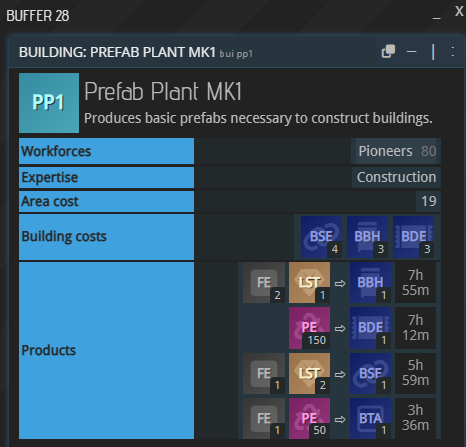
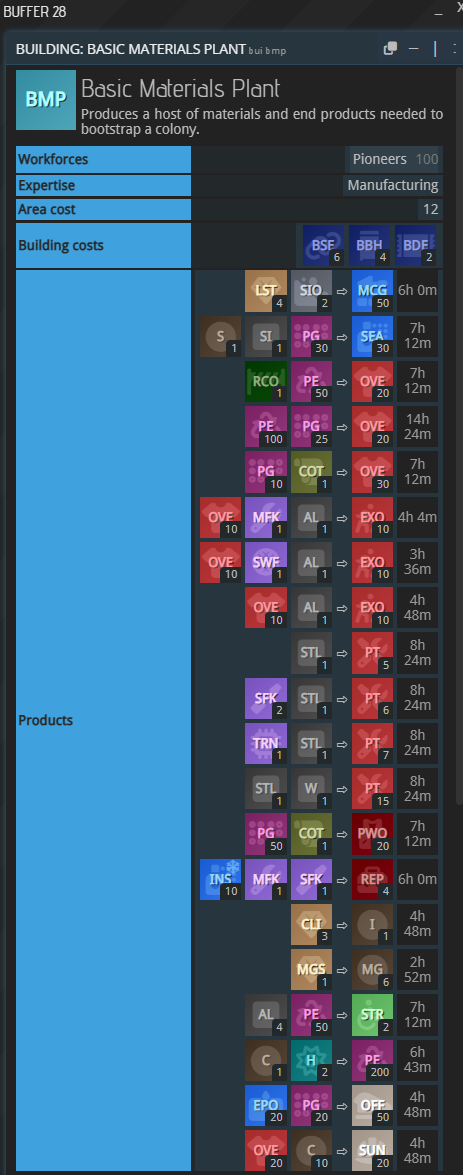
Since such a drastic price increase does not seem to be the solution (and may actually be detrimental), maybe there is a different way to tackle this issue than upending the entire Bfab market. That brings us to investigating what goes into making a Bfab. Meet the vaunted Prefab Plant MK1 (PP1), Prefab Plant MK2 (PP2) and Food Processor (FP):
Prefab Plant MK1 (PP1): 19 area, 80 pioneers
Prefab Plant MK2 (PP2): 25 area, 25 pioneers and 25 settlers
Food Processor (FP): 12 area, 40 pioneers
Not exactly what was expected? Fair, but you have to have a building and staff to make something first. Let’s go ahead and chart out the support structure of a building (first table) and then round out a build with regards to the best population fit (second table) – if only so we can get a comparison going.
| X | Buildings | Area | Pioneers | HB1 | HB Area | Settlers | HB2 | HB2 Area | Total Area | Leftover |
|---|---|---|---|---|---|---|---|---|---|---|
| PP1 | 1 | 19 | 80 | 1 | 10 | 0 | 0 | 0 | 29 | 20 PIO |
| PP2 | 1 | 25 | 25 | 1 | 10 | 25 | 1 | 12 | 47 | 75 Each |
| FP | 1 | 12 | 40 | 1 | 10 | 0 | 0 | 0 | 22 | 60 PIO |
Consumables
10 days of consumables:
PP1 - 32 RAT, 32 DW, 4 OVE, 4 COF, 1.6 PWO
PP2 - 25 RAT, 22.5 DW, 1.25 OVE, 1.25 EXO, 1.25 PT, 1.25 COF, 2.5 KOM, 0.5 PWO, 0.5 REP
FP - 16 RAT, 16 DW, 2 OVE, 2 COF, 0.8 PWO
| X | Buildings | Area | Pioneers | HB1 | HB1 Area | Settlers | HB2 | HB2 Area | Total Area |
|---|---|---|---|---|---|---|---|---|---|
| PP1 | 5 | 95 | 400 | 4 | 40 | 0 | 0 | 0 | 135 |
| PP2 | 4 | 100 | 100 | 1 | 10 | 100 | 1 | 12 | 122 |
| FP | 5 | 60 | 200 | 2 | 20 | 0 | 0 | 0 | 80 |
Consumables
10 days of consumables:
PP1 - 160 RAT, 160 DW, 20 OVE, 20 COF, 8 PWO
PP2 - 100 RAT, 90 DW, 5 OVE, 5 EXO, 5 PT, 5 COF, 10 KOM, 2 PWO, 2 REP
FP - 80 RAT, 80 DW, 10 OVE, 10 COF, 4 PWO
Sadly, I am not compelled to math out consumable cost over 4 CX’s (or even average it) as there’s a bit of variance. The goal here is to show that the PP1 isn’t that great compared to the PP2 when making Bfabs – and that is not mentioning that a PP2 can make Lfabs for more profit. When compared against the FP, the PP1 could use some rework here to make it a bit more attractive to place down on a planet. However, these would be minor changes to running a PP1, and would be too weak on their own to give Bfabs the rather dramatic change needed to meet the objectives.
That means investigating the various Bfab recipes, as changing them directly changes the value and price of each Bfab created. Since we have been benchmarking against the Food Processor and its items, we will continue to do so.
| Building | BBH | BDE | BSE | BTA | 10 DW | 7 DW | RAT |
|---|---|---|---|---|---|---|---|
| PP1 | 2 FE + 1 LST | 150 PE | 1 FE + 2 LST | 1 FE + 50 PE | |||
| PP2 | 2 AL + 1 LST | 40 PG | 1 AL + 2 LST | 1 AL + 1 GL | |||
| FP | 10 H2O + 1 PG | 10 H2O | 3 varied inputs |
So, question – why is each Bfab being hand-made from the highest quality wrought iron by the finest of Neo-Genoiese bloomery workers?
Before I try to answer that question, I want to pause here and go over a few points. When we compare these recipes with the ROI numbers earlier, it is plainly evident that PP2’s are not great at making Bfabs but they are here because the recipe exists. The switch in materials from FE to AL, PE to PG, and PE to GL is not really that meaningful, and same with the time reduction. The main strength of the PP2 here is the ability to produce Lfabs while the PP1 has no such other recipes. This is less about the PP2 being a competitor and more about how Bfabs just don’t make sense as they are currently implemented.
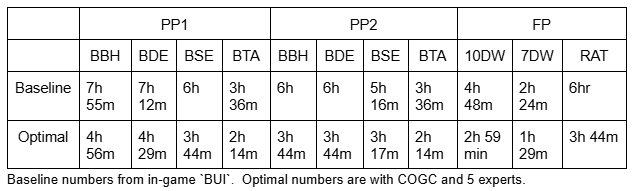
There are two restrictions on production: output volume and time. Reducing the time taken to produce a Bfab does not really change much, and while the timers seem high compared to the FP one must remember that FP produces daily consumables. Rather, adjusting material requirements for some buildings may be the better approach as some rather do stand out than adjusting the recipe timers. The following table looks at a single PP1 time-to-produce for various buildings, and you can scale the time taken yourself by adding additional PP1’s.
| Building | BBH | BDE | BSE | BTA | Unoptimized Solo PP1 | Optimized Solo PP1 |
|---|---|---|---|---|---|---|
| Collector | 16 | ~4 days | ~2.4 days | |||
| Smelter | 4 | 4 | 6 | ~4 days | ~2.5 days | |
| Food Processor | 3 | 3 | 3 | ~2.6 days | ~1.6 days | |
| Pioneer Habitat | 4 | 2 | 2 | 1 | ~2.5 days | ~1.6 days |
Furthermore, while reducing the timer means that slightly more Bfabs can be produced within a 24 hour window it doesn’t do anything to improve the margin of Bfabs to attract producers - each Bfab produced still incurs the same cost. This would be a good adjustment for fine-tuning, but not to solve the issue at hand.
Now that everything else has been examined and found to not have the impact(s) desired, there is only the recipes themselves remaining.
I can only assume that Bfabs are designed to work within a Market Maker price ceiling - after all, no Bfabs means no growth. This means that the alternative to increasing the Market Maker is to change the recipe to allow Bfabs to work within this price ceiling. Since Bfabs have an input cost and a fungible value, there are two solutions: Reduce the recipe cost or increase the output amount. The first is going to be rather difficult to do as some recipes are working with single units - thus necessitating a deeper rework. The second is much simpler to do.
For the sake of argument, let’s double the output of the PP1 Bfab recipes:
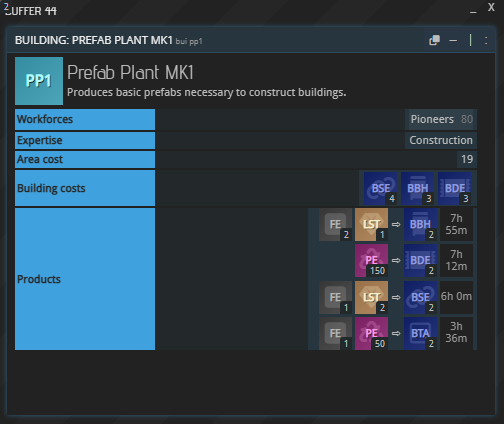
By doubling the output, it is possible apply both symmetric and distributive properties and thus treat a doubling of output as a halving of input:
2 FE + 1 LST = 2 BBH == 2(1 BBH = 1 FE + 0.5 LST)
This change is thus relatively minor to implement (and thus fix in the current iteration of the universe without much development time) but has major impacts. As previously, there are three goals that this change can be measured against:
-
Bfabs should be cheap enough for new players to purchase.
This solution keeps Bfabs cheap by removing the need to increase the Market Maker price ceiling. -
Bfabs should be available enough to supply the market against all but the worst economic pressure.
This solution increases Bfab availability directly - you get more Bfabs for your Bfab recipe. -
Bfabs should be profitable enough for people to make them.
This solution increases Bfab ROI by (depending on your view) doubling the output value or halving the input cost, thus capturing increased revenue for the producers.
However, would a doubling of Bfab output be enough to reduce the current ROI numbers to be attractive *enough*? I do not know, nor am I able to calculate (especially how the market would react to such a change). What I have done is take the naive assumption that doubling the output halves the ROI. This most likely is incorrect, and will probably be the main source of controversy, but I assume this because I am no economist, statistician, or have in-depth game formulas to simulate this - it is to illustrate a quick and simple point. That point is the following chart, which shows what a doubling of ROI would do.
| Item | ANT (AI1_BUY_SELL) | HRT (IC1_BUY/SELL) | BEN (CI_BUY/SELL) | MOR (NC_BUY/SELL) |
|---|---|---|---|---|
| BBH | 41.92 / 20.96 | 14.28 / 7.14 | 27.07 / 13.535 | 21.88 / 10.94 |
| BDE | 14.95 / 7.475 | 19.52 / 9.76 | 13.35 / 6.675 | 13.39 / 6.695 |
| BSE | 46.82 / 23.41 | 21.23 / 10.615 | 22.24 / 11.12 | 27.93 / 13.965 |
| BTA | -26.29 / -13.145 (??) | 20.63 / 10.315 | 44.03 / 22.015 | 36.35 / 18.175 |
| DW | 13.74 / 17.44d | 13.78 / 15.74 | 12.19 / 12.73 | 12.96 / 16.34 |
| RAT | 10.19 / 12.21d | 10.61 / 12.87 | 10.17 / 13.85 | 10.70 / 12.31 |
Note
Modified ROI chart - original PP1 numbers on left / halved ROI numbers on right.
I am unable to determine if a doubling of output would make PP1 Bfab production attractive enough as the market does have a say for material prices. My naive assumption of “more product for no additional material and production cost” may also be only an ROI increase by a third rather than double. It may be that increasing output even more could be considered depending on market reactions to this change, or a redesign of some recipes in the future to try for the desired outcome. However, that is beyond the scope of this analysis. I am simply looking for the most impactful change to make Bfabs viable with the least amount of developer resistance - and by far the largest impact is the recipe output.
To conclude, I believe that the current Bfab recipes are one of the main root causes of this issue, and one of the simplest solutions to implement. The market performance is lagging behind other materials for something quite fundamental to the workings of the universe. As I hope to have shown above, there are ways to help reduce this pressure but the only way to enact the desired change without having to do a major intervention (or wait for a new universe) is to double the output.
I would be interested in hearing the thoughts and analysis of other players though, to see what other ideas people have.